


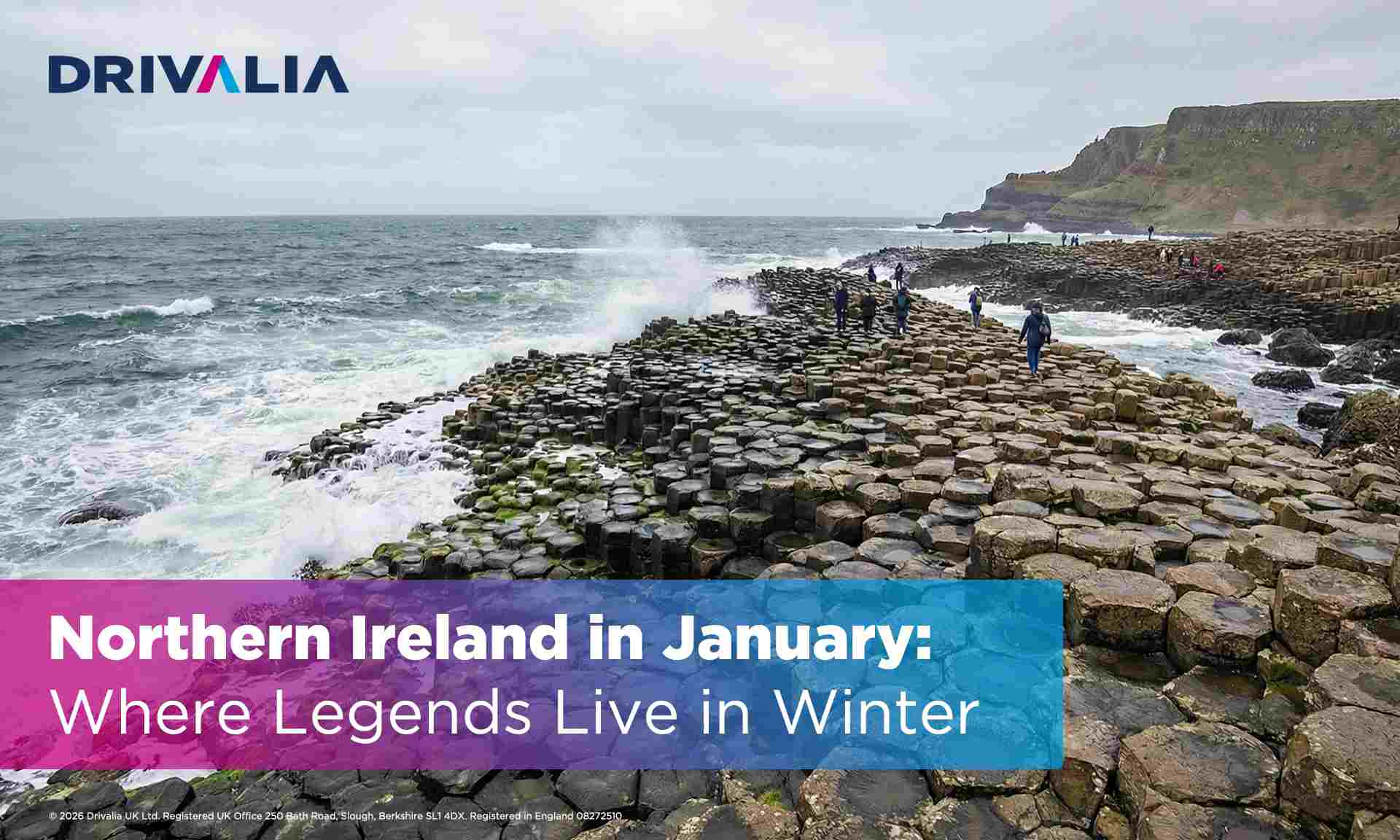
Northern Ireland in January is a land of myths come to life. Giants’ causeways emerge from storm-tossed seas, medieval castles stand sentinel over windswept coasts, and the warmth of Irish hospitality blazes brighter than any fire.
This compact corner of Ireland packs extraordinary variety into its borders, from dramatic coastlines and fascinating cities to tranquil lakelands and mountains steeped in legend. Here’s where to discover Northern Ireland when winter reveals its most atmospheric character.
1. The Causeway Coast: Nature’s Masterpiece Uncrowded
The Causeway Coastal Route ranks among the world’s great scenic drives, and January transforms it into something truly special. The Giant’s Causeway, a formation of 40,000 interlocking basalt columns created by volcanic activity 60 million years ago, takes on dramatic intensity when Atlantic storms crash around its geometric formations.
This UNESCO World Heritage site becomes your private geological wonder, with space to truly appreciate nature’s architecture.
The rope bridge at Carrick-a-Rede, suspended 30 metres above the sea, offers an exhilarating crossing experience, but January visitors should plan carefully.
The bridge often has restricted winter opening hours or closes for extended maintenance during the colder months. Time slots must be booked in advance online through the National Trust website, so always check availability before making the journey.
Dunluce Castle, perched precariously on coastal cliffs, looks particularly atmospheric when mist swirls through its medieval ruins. It’s pure Game of Thrones territory, and indeed, the show filmed extensively along this coast.
Bushmills, home to the world’s oldest licensed whiskey distillery (granted its licence to distil in 1608), provides warming tours and tastings that feel especially welcome in January weather.
The coastal towns of Portrush, Portstewart, and Ballycastle offer excellent seafood restaurants, traditional pubs, and accommodation with sea views and the kind of hospitality that defines an Irish welcome.
2. Belfast: City of Transformation and Triumph
Belfast has transformed into one of Europe’s most exciting cities, and January showcases its cultural richness without summer crowds. The Titanic Belfast museum, built on the actual Harland & Wolff slipways where the ill-fated liner was constructed, offers utterly absorbing exploration of Belfast’s shipbuilding heritage and the Titanic story.
The building itself, clad in shimmering aluminium, represents architectural excellence.
The Cathedral Quarter buzzes with street art, independent cafes, and traditional pubs hosting live music sessions. Crown Liquor Saloon, a Victorian gin palace maintained by the National Trust, offers ornate beauty and proper Irish atmosphere.
St. George’s Market runs on Fridays (Variety Market), Saturdays (City Market), and Sundays (Food and Craft Market), showcasing local produce, artisan goods, and the friendly craic that makes Belfast special.
Belfast’s political murals provide powerful insights into the city’s complex history. Black cab tours, led by knowledgeable locals, offer balanced perspectives on the Troubles and the peace process. These tours are consistently rated as highlights by visitors seeking to understand Belfast’s journey.
The city’s restaurant scene absolutely thrives. From Michelin-starred fine dining to authentic Ulster fry breakfasts, Belfast delivers culinary excellence.
The city’s proximity to coast and countryside means the freshest ingredients, including Strangford Lough oysters, Glenarm salmon, and County Down beef, all feature prominently on menus across the city.
For visitors arriving by air, arranging car rental at Belfast International Airport is a practical first step. Having your own vehicle makes it simple to explore Belfast at your own pace before heading out to discover the coastlines, mountains, and lakelands that lie within easy reach of the city.
3. The Mourne Mountains: Where Mountains Sweep Down to the Sea
The Mourne Mountains, immortalised in Percy French’s song, offer spectacular winter walking and Northern Ireland’s highest peaks. Slieve Donard, at 850 metres, provides a challenging but rewarding ascent with views across the Irish Sea to Scotland, the Isle of Man, and Wales on clear days.
The Mourne Wall, a 35-kilometre dry stone wall crossing fifteen summits, represents a Victorian engineering marvel and an excellent hiking objective.
Newcastle, at the mountains’ foot, serves as the perfect base. This traditional seaside town offers comfortable accommodation, excellent pubs serving hearty food, and direct access to mountain trails.
The Mourne Heritage Trust provides information on routes and conditions, which is essential for January hiking when weather can change rapidly.
Tollymore Forest Park, at the Mournes’ base, offers easier walking through ancient woodland with a mountain backdrop. The park’s stone bridges and river gorges provided Game of Thrones filming locations, adding fantasy appeal to natural beauty.
Silent Valley reservoir, surrounded by peaks, showcases the mountains’ grandeur from a more accessible setting.
4. Derry-Londonderry: Walled City with Cultural Soul
Derry-Londonderry’s 17th-century walls remain the only completely intact city walls in Ireland and one of the finest examples in Europe, providing a circuit walk with views across the city and River Foyle. The city’s complex history unfolds through its museums.
The Museum of Free Derry and Tower Museum offer essential context for understanding Northern Ireland’s recent past.
The Guildhall, with its remarkable stained glass windows, represents Victorian civic pride, while the Peace Bridge symbolises contemporary reconciliation. The city’s street art, particularly the murals in the Bogside, provides powerful visual storytelling of conflict and hope.
Derry’s food scene rivals Belfast’s, with excellent restaurants serving everything from traditional Irish stew to international cuisine.
The city’s pubs host legendary music sessions. Peadar O’Donnell’s and The Gweedore Bar regularly feature live traditional music that captures Irish culture at its most authentic.
The nearby Sperrin Mountains and Roe Valley Country Park offer countryside escapes, while the city’s position makes it an excellent base for exploring Donegal’s dramatic coastline just across the border.
5. The Glens of Antrim: Coastal Valleys of Romance
The nine Glens of Antrim, valleys cutting through the Antrim plateau to the sea, offer some of Northern Ireland’s most romantic landscapes. Glenariff, the “Queen of the Glens,” features spectacular waterfalls cascading through forested gorges.
The Glenariff Forest Park provides walking trails ranging from easy riverside strolls to challenging mountain hikes.
The coastal villages of Cushendall, Cushendun, and Carnlough preserve traditional character with colourful houses, working harbours, and excellent pubs. Cushendun, in particular, captivates visitors with its distinctive Cornish-style cottages and Game of Thrones cave locations.
The Glens’ position on the Causeway Coastal Route makes them perfect stopping points between Belfast and the Giant’s Causeway.
Local accommodation ranges from country house hotels to cosy B&Bs, all offering genuine hospitality and hearty Ulster breakfasts. The area’s craft shops showcase local pottery, textiles, and artwork inspired by the landscape.
6. Fermanagh Lakelands: Tranquil Beauty and Ancient Sites
County Fermanagh’s landscape of islands, waterways, and rolling hills offers peaceful contrast to coastal drama. Lough Erne, actually two connected lakes, provides the centrepiece, and its 154 islands hold ancient monastic sites, castles, and abundant wildlife.
Enniskillen, the county town built on an island between the two loughs, offers a Norman castle, independent shops, and excellent restaurants. The town serves as a gateway to the lakelands and provides comfortable accommodation with lakeside views.
Devenish Island, accessible by ferry from Enniskillen, preserves one of Ireland’s most important monastic sites, including a 12th-century round tower and ancient church ruins that evoke Ireland’s golden age of saints and scholars.
Nearby Florence Court and Castle Coole, both National Trust properties, showcase Georgian aristocratic life with magnificent architecture and parklands.
Do note that the Marble Arch Caves are typically closed throughout January for essential maintenance and due to high water levels caused by winter rainfall.
If underground exploration is on your wish list, check the official website well in advance, but it is best not to count on a visit during a midwinter trip. The surrounding area’s lakeshore walks and quiet roads, however, remain open and rewarding for those seeking tranquillity and nature.
7. Armagh: Spiritual Capital and Georgian Grace
Armagh, ecclesiastical capital of Ireland, features twin cathedrals, Catholic and Church of Ireland, sitting on opposing hills, each magnificent in its own right. The city’s Georgian architecture, particularly the Mall, creates elegant streetscapes that January’s softer light enhances beautifully.
The Armagh Observatory and Planetarium offers fascinating astronomical exhibits and shows, which are particularly atmospheric during January’s long nights. The Navan Centre interprets the nearby Navan Fort, seat of ancient Ulster kings and one of Ireland’s most significant archaeological sites.
Armagh’s reputation for food excellence means outstanding restaurants and traditional pubs serving local specialities. The nearby Orchard County countryside, famous for apple growing, provides scenic drives through rolling farmland.
8. Strangford Lough: Wildlife Haven and Village Appeal
Strangford Lough, a vast sea inlet south of Belfast, creates protected waters rich with marine life. The lough’s shores host delightful villages, including Strangford, Portaferry, and Killyleagh, each offering harbour views, excellent seafood, and a warm village atmosphere. The Exploris Aquarium in Portaferry showcases the lough’s remarkable biodiversity.
Mount Stewart, a National Trust property, combines a magnificent house with extraordinary gardens. Even in January, the gardens, benefiting from the lough’s mild microclimate, offer interest with architectural bones, evergreens, and early spring bulbs. The house contains remarkable art and furnishings.
Castle Ward, another National Trust property, provided Winterfell filming locations for Game of Thrones. The estate’s classical and Gothic facades represent architectural uniqueness, while the parkland offers lakeside walks with mountain views.
Portaferry to Strangford ferry provides a scenic crossing with seals often visible. The area’s seafood restaurants serve outstanding oysters, mussels, and fish. Strangford Lough’s ecological richness translates directly to plate excellence.
9. The Sperrins: Mountain Wilderness Undiscovered
The Sperrin Mountains, Northern Ireland’s largest upland area, remain wonderfully undiscovered. These rolling, heather-clad mountains offer solitude, spectacular views, and genuine wilderness character. The area’s significant gold deposits add geological interest, as the Sperrins have historically been the most notable gold-producing area in Ireland and the UK.
Villages like Draperstown and Gortin provide bases for exploration, with traditional pubs and B&Bs offering genuine rural hospitality. The Ulster American Folk Park near Omagh tells the powerful story of Irish emigration to America through reconstructed buildings and costumed interpreters.
Walking trails range from gentle valley strolls to challenging mountain ascents. The Sperrins’ relative obscurity means you’ll often have trails entirely to yourself, and January intensifies this splendid isolation.
10. Rathlin Island: Remote Beauty and Rugged Coastline
For true adventurers, Rathlin Island offers remote island atmosphere just 25 minutes by ferry from Ballycastle (weather-dependent service). Northern Ireland’s only inhabited offshore island hosts around 150 residents, and its rugged cliffs, quiet roads, and sense of timelessness create an escape from modern pressures.
It is worth noting that January is not the time for seabird watching on Rathlin. Puffins, guillemots, and razorbills spend the winter months far out at sea, typically not returning to the island’s cliffs until late March or April. The West Light Seabird Centre is usually closed during this period.
However, the island’s wild coastal scenery, lighthouse views, and genuine sense of isolation make it a rewarding visit in its own right for those who enjoy raw, windswept landscapes.
Robert the Bruce famously sheltered in Rathlin’s caves while regrouping after defeats, and the island’s atmosphere of refuge and renewal remains tangible. Basic but comfortable accommodation and genuine island hospitality reward those who make the journey.
Practical Northern Irish Wisdom
Northern Ireland in January requires flexibility and proper preparation. Pack waterproofs as standard, as Irish weather delivers regular showers between bright spells. Layering works best: base layers, warm mid-layers, and waterproof shells.
Good walking boots prove essential for countryside exploration.
January days are short, with sunrise around 8:30am and sunset by 4:30pm, but the quality of light, particularly along the coast, creates spectacular photography conditions. Weather changes quickly: be prepared for wind, rain, and occasional bright sunshine, sometimes within the same hour.
A word on seasonal closures: January is the quietest month in Northern Ireland, and some managed outdoor attractions take the opportunity to close for maintenance.
Always check opening times on official websites before visiting sites such as Carrick-a-Rede rope bridge, the Marble Arch Caves, and the Rathlin Island Seabird Centre. The major year-round attractions, including the Giant’s Causeway, Titanic Belfast, and the city museums, remain open as normal.
Northern Ireland’s compact size means efficient exploration. You can drive coast to coast in two hours, making multi-destination trips entirely feasible.
Roads are excellent, and the Causeway Coastal Route offers one of Europe’s great scenic drives. Public transport connects major towns and cities reliably.
Accommodation offers outstanding value in January. Traditional Irish hospitality shines year-round, but winter brings extra warmth, both literally and metaphorically. Book places with good restaurants or near village centres for maximum comfort and convenience.
Best time to visit: Mid-January offers settled conditions after New Year celebrations. Expect 4-7°C temperatures, frequent but brief showers, and dramatic skies. Pack waterproofs, embrace the weather, and discover Northern Ireland at its atmospheric best.